 Seekprotocol
 claim thresholds
Updated on
Seekprotocol is an augmented reality app for location-based rewards, including crypto assets. Its Whitepaper v1.6, updated August 2026, describes a verification model in which each asset sets the confidence score that a claim must meet. Low-value quests and high-value ticketed-event drops can impose different requirements, so presence inside the radius alone does not establish reward eligibility.
Contents
Page contents
How can quest and event thresholds differ?
- Low-value quest reward
- A moderate combined score can be sufficient. Weighting allows the model to tolerate an unreliable signal when the remaining evidence meets that asset's requirements. Weak satellite reception underground is one reason that requiring every signal could exclude an honest claim.
- High-value ticketed-event drop
- The asset can demand device attestation and a matching radio environment. These requirements seek stronger corroboration before a more valuable reward is released. Their enforcement depends on the applicable implementation and configuration.
A claim can meet a quest's confidence requirement and fall below an event drop's requirement without any change in the device's location.
Which signals contribute to the score?
- Satellite position
- The GNSS fix contributes coordinates, reported accuracy, and information about the satellite constellation and count.
- Ambient radio
- Nearby Wi-Fi networks and cell towers are compared with the radio environment expected at the location.
- Device attestation
- The model names Play Integrity on Android, and DeviceCheck or App Attest on iOS, to assess app and device integrity.
- Motion and travel time
- Motion continuity uses the accelerometer trace between confirmed positions. A separate temporal-plausibility check compares arrival times with the implied travel time.
The implementation section of Whitepaper v1.6 reports GNSS, attestation, and motion continuity running. It describes radio fingerprinting as a staged rollout and says attestation enforcement was not enabled on every surface. The enforced checks for a particular claim therefore depend on that surface's deployment and configuration.
The document labels its sample scoring weights illustrative. Those weights do not establish the live threshold or enforced checks for a particular quest or event.
A hypothetical score across two rewards
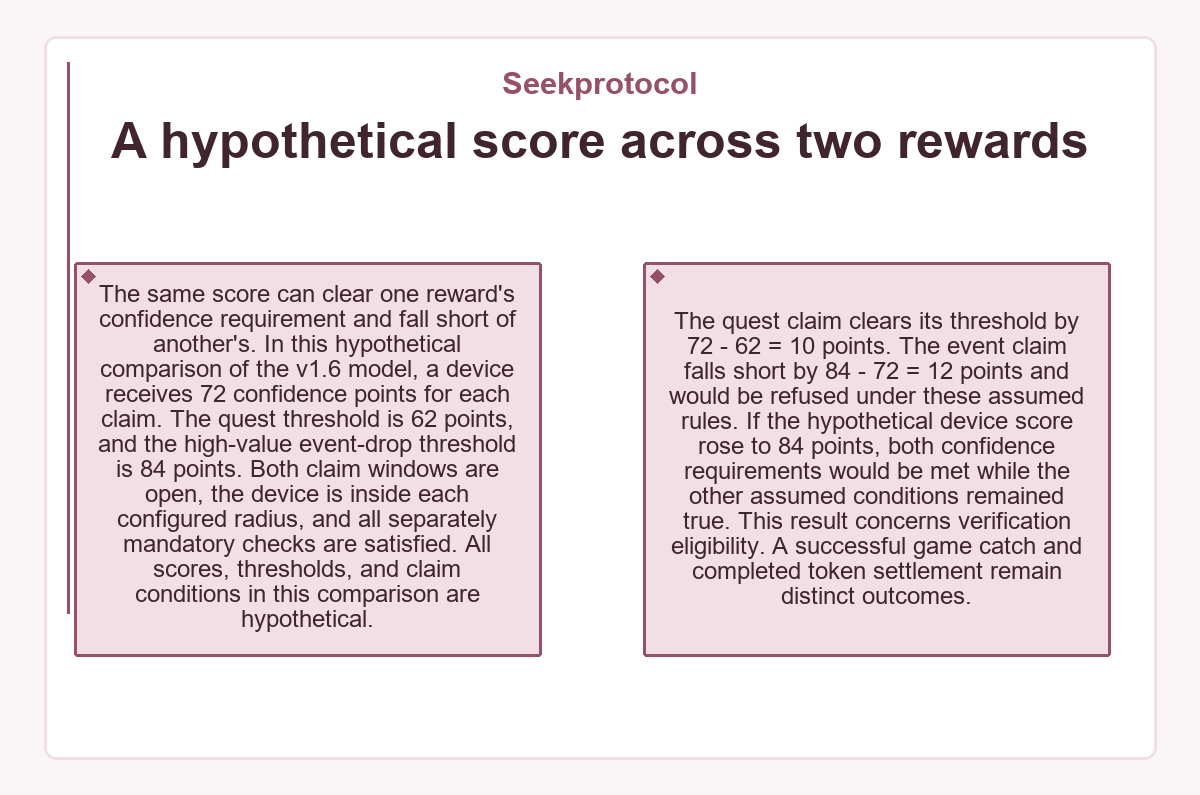
The same score can clear one reward's confidence requirement and fall short of another's. In this hypothetical comparison of the v1.6 model, a device receives 72 confidence points for each claim. The quest threshold is 62 points, and the high-value event-drop threshold is 84 points. Both claim windows are open, the device is inside each configured radius, and all separately mandatory checks are satisfied. All scores, thresholds, and claim conditions in this comparison are hypothetical.
The quest claim clears its threshold by
72 - 62 = 10
points. The event claim falls short by
84 - 72 = 12
points and would be refused under these assumed rules.
If the hypothetical device score rose to 84 points, both confidence requirements would be met while the other assumed conditions remained true. This result concerns verification eligibility. A successful game catch and completed token settlement remain distinct outcomes.
What do refusal and settlement states mean?
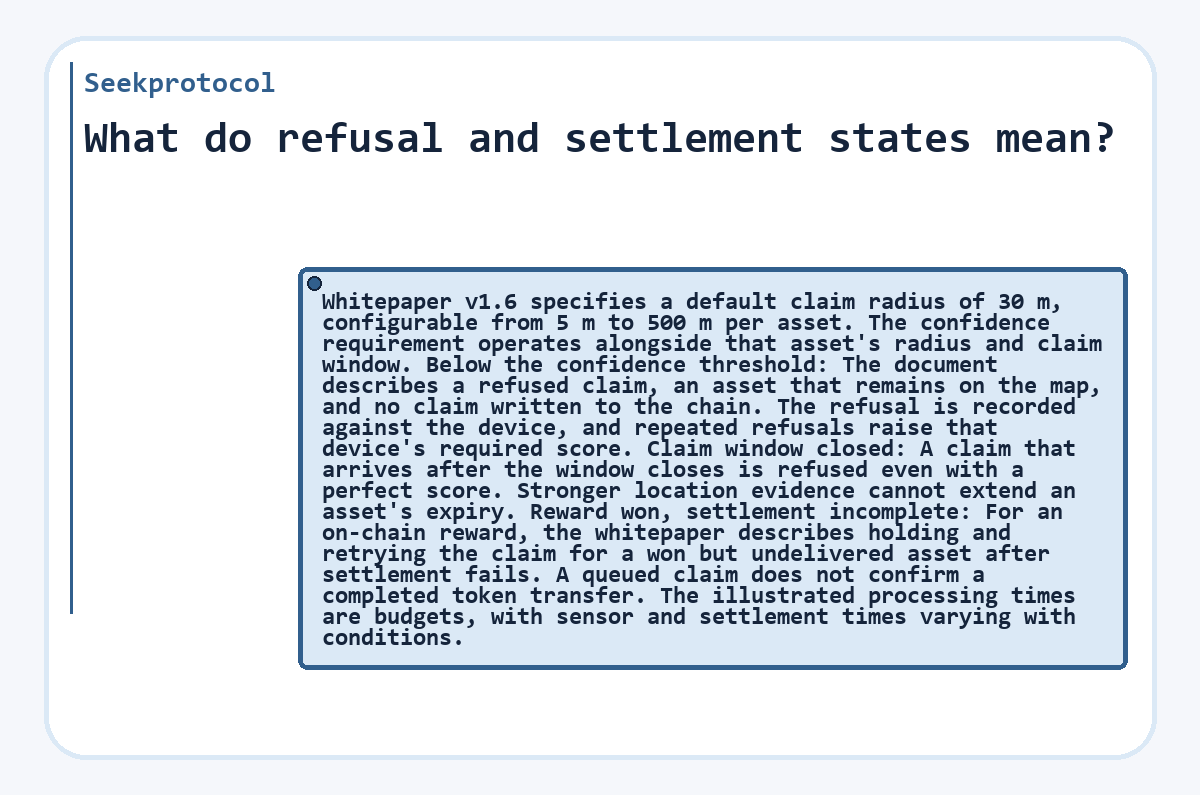
Whitepaper v1.6 specifies a default claim radius of 30 m, configurable from 5 m to 500 m per asset. The confidence requirement operates alongside that asset's radius and claim window.
- Below the confidence threshold
- The document describes a refused claim, an asset that remains on the map, and no claim written to the chain. The refusal is recorded against the device, and repeated refusals raise that device's required score.
- Claim window closed
- A claim that arrives after the window closes is refused even with a perfect score. Stronger location evidence cannot extend an asset's expiry.
- Reward won, settlement incomplete
- For an on-chain reward, the whitepaper describes holding and retrying the claim for a won but undelivered asset after settlement fails. A queued claim does not confirm a completed token transfer. The illustrated processing times are budgets, with sensor and settlement times varying with conditions.
What can stronger verification establish?
A higher evidence requirement can also exclude legitimate devices. The whitepaper notes that an older operating-system version can fail attestation for reasons unrelated to fraud. Indoor positioning is less accurate than outdoor positioning; its indoor design uses wider radii and relies more on radio fingerprinting, subject to the rollout qualification above.
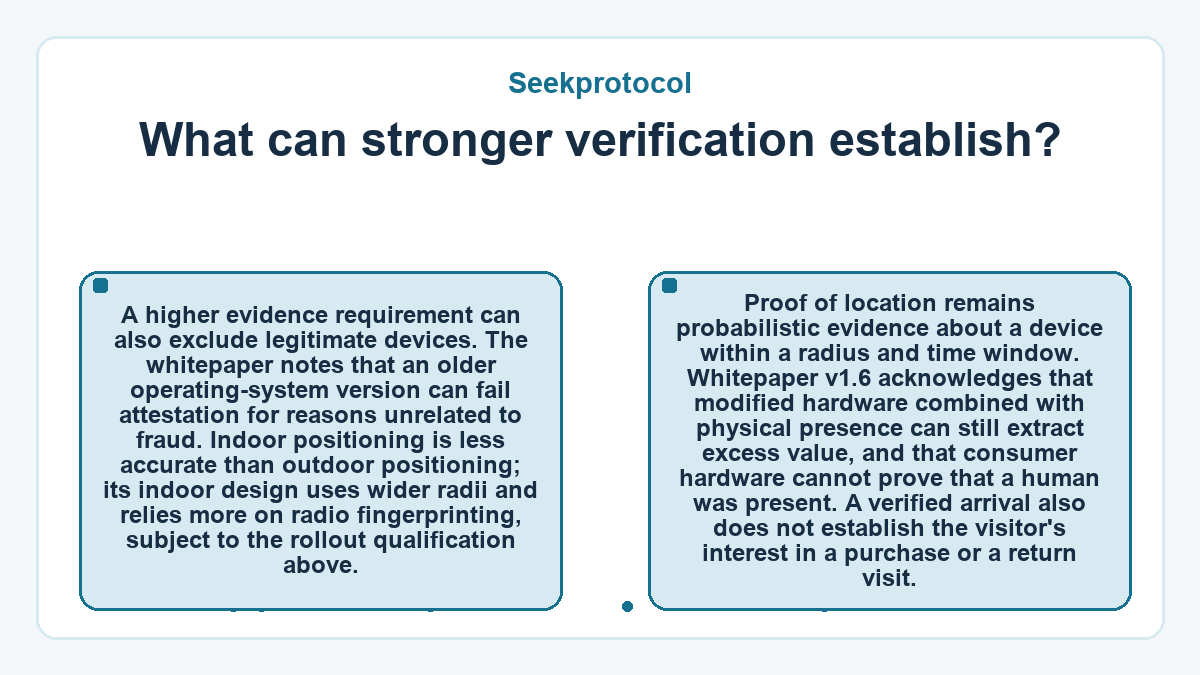
Proof of location remains probabilistic evidence about a device within a radius and time window. Whitepaper v1.6 acknowledges that modified hardware combined with physical presence can still extract excess value, and that consumer hardware cannot prove that a human was present. A verified arrival also does not establish the visitor's interest in a purchase or a return visit.